How to Scale Large-Format Vodka Cocktails for a Crowd
The central question in scaling a vodka cocktail is not simply “How do I make more?” It is “How do I preserve the drink’s balance while controlling…
- Finished volume: the base ingredients plus planned water and any mixer added at service.
- Alcohol concentration: the volume of pure alcohol divided by the finished liquid volume.
- Portion: the amount placed in each glass, which determines both yield and alcohol per serving.
- Vodka makes this especially revealing.
- Because an unflavored vodka generally contributes less sugar, acidity or dominant aroma than many liqueurs, errors in citrus, syrup or dilution can become obvious.
The central question in scaling a vodka cocktail is not simply “How do I make more?” It is “How do I preserve the drink’s balance while controlling water, temperature, bubbles, strength and portion size?” After reading this guide, you will be able to turn a single-serving formula into a measurable batch, select a container that fits it and predict what each guest will receive.
What scaling a cocktail actually means
Scaling begins with proportional multiplication: if one serving contains 2 fl oz of vodka, eight servings require 16 fl oz. But a finished cocktail is more than its listed ingredients. Shaking or stirring introduces water, chilling changes how sweetness and acidity are perceived, ice may continue melting, and sparkling mixers lose carbonation when handled too early.
A successful large-format cocktail therefore preserves four related quantities:
- Ingredient ratio: the relationship among vodka, acidic, sweet and other flavoring components.
- Finished volume: the base ingredients plus planned water and any mixer added at service.
- Alcohol concentration: the volume of pure alcohol divided by the finished liquid volume.
- Portion: the amount placed in each glass, which determines both yield and alcohol per serving.
Vodka makes this especially revealing. Because an unflavored vodka generally contributes less sugar, acidity or dominant aroma than many liqueurs, errors in citrus, syrup or dilution can become obvious. A batch that is mathematically proportional can still taste different if its temperature and water content differ from the original serve.
Build the batch from one known serving
Write down every liquid in one serving before multiplying anything. Include small quantities such as bitters, saline or concentrated flavoring; repeated across a crowd, an omitted dash can become a meaningful difference. Convert awkward measures to a consistent unit before calculating. One US fluid ounce equals 29.5735 millilitres, although sensible culinary rounding is appropriate when the measuring equipment cannot reproduce decimal-level precision.
The basic calculation is:
batch quantity = quantity in one serving × intended number of servings
If the original recipe uses “parts,” add those parts to find the total per-serving ratio. A 4:2:1 formula has seven total parts. For a 1,400 ml undiluted base, each part is 200 ml, producing 800 ml, 400 ml and 200 ml respectively. Parts preserve proportion, but they do not account for chilling water or a carbonated topping.
Measure dilution instead of guessing
Shaking and stirring chill a drink partly by melting ice. In a large batch, simply multiplying the ingredients omits that water. Serving the undiluted mixture over ice may eventually correct it, but the first and last glasses can differ substantially.
A practical way to establish a dilution allowance is to prepare one serving with the intended ingredients and technique. Measure its liquid volume before chilling and again after straining. The increase is an estimate of the water introduced under those conditions. Multiply that increase by the batch yield.
This is not a universal scientific constant. Ice size, starting temperature, mixing time and equipment all affect melt. Treat the single-drink measurement as a repeatable house specification, not a law for every cocktail. If the batch will be thoroughly chilled and poured over fresh ice, adding the measured water in advance offers more control. If it will sit on a large ice block, begin with less added water and accept that the drink will evolve during service.
A fully calculated eight-serving example
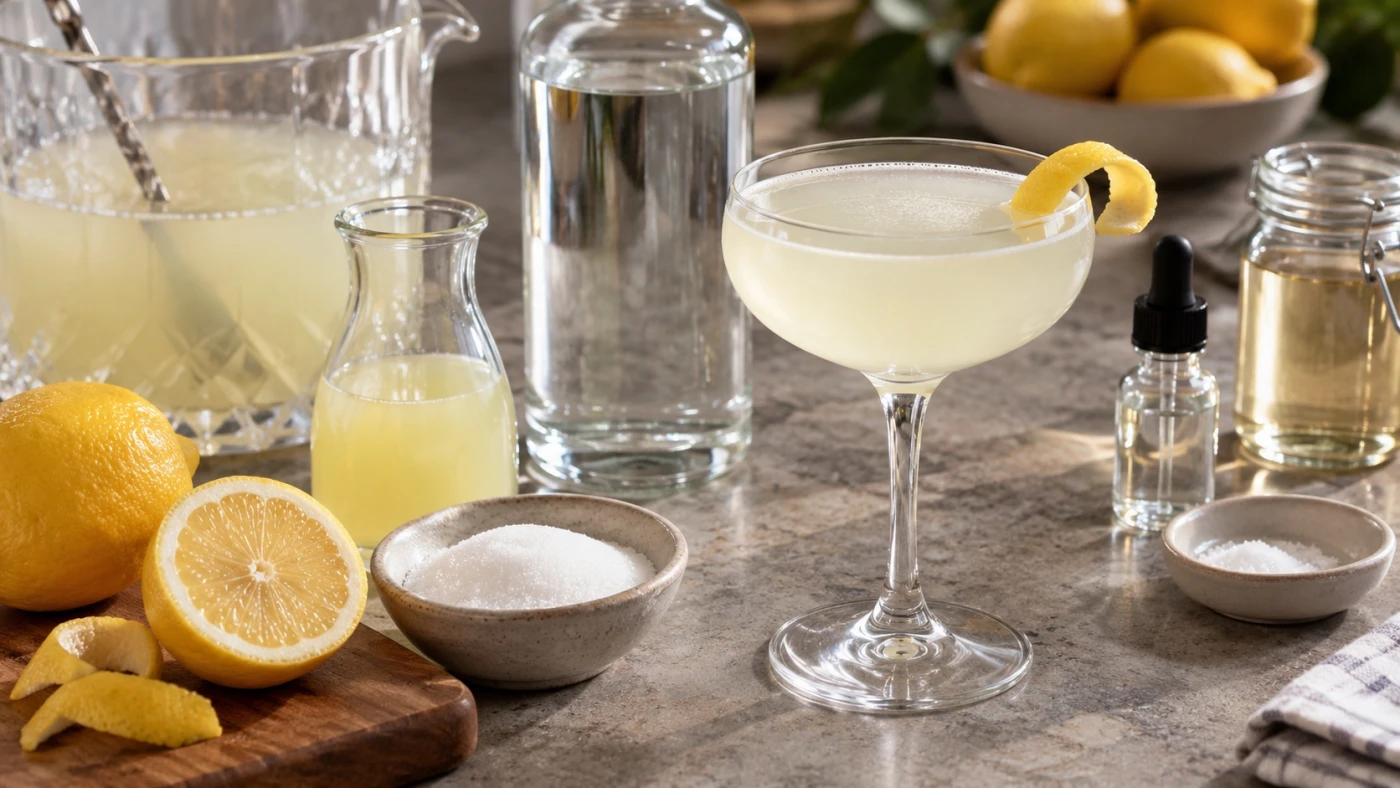
Consider a still vodka sour-style drink containing, per serving, 2 fl oz (about 59 ml) vodka, 0.75 fl oz (about 22 ml) lemon juice and 0.5 fl oz (about 15 ml) syrup. Suppose a measured single-serving trial shows that 0.75 fl oz (about 22 ml) water reproduces the desired post-shake dilution.
For eight servings, combine 16 fl oz (about 473 ml) vodka, 6 fl oz (about 177 ml) lemon juice, 4 fl oz (about 118 ml) syrup and 6 fl oz (about 177 ml) chilled water. Stir until uniform, keep the batch chilled and divide it evenly among eight ice-filled glasses.
The arithmetic audit is:
- 16 + 6 + 4 + 6 = 32 fl oz total, approximately 946 ml.
- 32 fl oz ÷ 8 = 4 fl oz per serving, approximately 118 ml.
- Eight servings × 4 fl oz = 32 fl oz, matching the batch total.
- A 1.25 litre jug provides approximately 304 ml of unused capacity above a 946 ml batch. That is sufficient for gentle stirring, but the jug should not be shaken.
The rounded metric components total approximately 945 ml rather than 946 ml; that one-millilitre difference is a consequence of rounding the individual conversions, not a missing ingredient.
If the vodka is 40% alcohol by volume, the vodka contributes 16 × 0.40 = 6.4 fl oz of pure alcohol. Dividing 6.4 by the 32 fl oz finished batch gives an estimated 20% ABV before ice in the serving glasses melts. Each portion contains 2 fl oz of that vodka. Check the actual label rather than assuming every vodka is 40% ABV; US distilled-spirit labels are required to state alcohol content, according to the Alcohol and Tobacco Tax and Trade Bureau.
Adjust the plan for citrus, bubbles and ice
Fresh citrus: Multiply it like any other liquid, but taste the completed base before service. Fruit varies in acidity, so the calculated amount is a repeatable starting point rather than proof that every batch will taste identical. Make small, measured corrections and record them.
Carbonated mixers: Calculate their total quantity, but add them gently near service or portion the still base into glasses and top each glass individually. Early mixing, vigorous stirring and repeated opening encourage loss of carbonation. Do not shake a carbonated mixture or seal it in a container that is not designed for pressure.
Ice: Decide whether ice is primarily chilling, diluting or both. Prediluting a refrigerated batch and pouring it over fresh glass ice gives tighter portion control. Putting ice in the serving vessel is simpler, but the cocktail becomes progressively more diluted.
Garnishes: Garnishes do not alter the liquid-volume calculation unless they release substantial juice or another liquid. Prepare enough for the planned number of portions, plus a modest operational allowance, without treating garnish count as extra cocktail yield.
Choose vodka and calculate strength deliberately
For a citrus-forward or long mixed drink, a clean vodka at the formula’s expected strength is usually more important than buying the most expensive bottle. A flavored or unusually high-strength vodka is not a neutral substitution: it can change sweetness, aroma and final ABV. Read the label and recalculate when the strength differs.
For a batch containing one alcoholic ingredient, estimated ABV is:
(vodka volume × vodka ABV) ÷ finished batch volume
When a drink also contains liqueur, vermouth or another alcoholic ingredient, calculate the pure-alcohol contribution of each and add them before dividing by finished volume. This remains an estimate because real volumes may not combine with laboratory precision and later ice melt changes concentration.
Do not confuse lower concentration with less total alcohol. Adding water or mixer reduces ABV but leaves the batch’s total alcohol unchanged. Portion control is therefore essential. The US National Institute on Alcohol Abuse and Alcoholism defines a US standard drink as 0.6 fl oz or 14 g of pure alcohol and notes that a mixed drink can contain one or more standard drinks; its standard-drink guidance is useful when assessing a batch. UK units use a different convention, so the two systems should not be treated as interchangeable.
Match the container to the finished volume
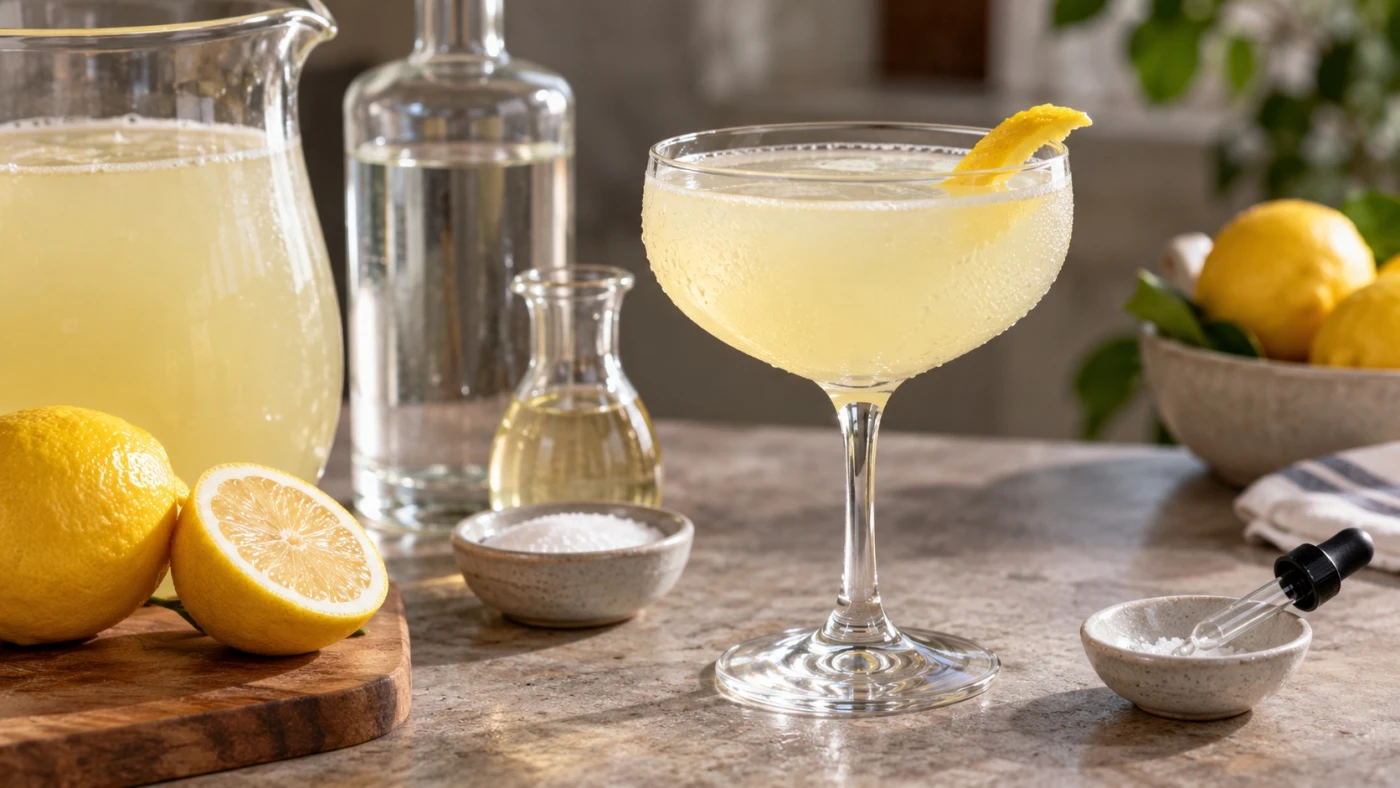
Add every liquid—including planned water and any mixer that will enter the vessel—to establish the required capacity. The container must hold more than the calculated total because stirring, carrying and pouring require headspace.
A nominal one-litre bottle is unsuitable for the 946 ml example if ingredients must be mixed inside it: only about 54 ml of headspace remains. A 1.25 litre jug is more workable for gentle stirring. If the batch must be shaken, use a purpose-appropriate vessel with substantially more free space and a secure closure; otherwise, divide the liquid and shake individual portions.
Also check whether the vessel can be refrigerated, whether its tap can pass pulp and whether guests can identify the serving size. A marked measure or known-volume glass helps prevent accidental overpouring.
Common misconceptions about large-format cocktails
“Multiplication is the whole job.” Multiplication preserves the ingredient ratio, but not necessarily the finished drink. Water, temperature, bubbles and portion size remain separate decisions.
“A dispenser full of ice solves dilution.” It creates changing dilution. Early pours and late pours will not be equivalent unless service is fast and tightly controlled.
“More mixer makes the batch safer.” More non-alcoholic liquid lowers concentration, but it does not remove any of the alcohol already present. Smaller, defined portions are the meaningful control.
“Any vodka can be substituted without recalculating.” Vodkas can differ in alcohol strength, and flavored products may add sweetness or aroma. The label, not the category name alone, supplies the number needed for an ABV calculation.
“Metric and US customary quantities should match digit for digit.” They represent the same quantities using different units. Practical rounded conversions can differ by a millilitre or two across a batch, so choose one unit system for production rather than alternating between both.
The decision rule to remember
Start with one balanced serving, multiply its components, add a measured dilution allowance, and then verify the total against both the intended yield and the container. Keep carbonation as late as practical, define the pour size and calculate strength from the actual bottle label. That sequence turns large-format vodka cocktails from guesswork into a controlled serving plan.
Ask AI about this article
Pick a prompt, copy it, or open ChatGPT with this article preloaded.
Frequently Asked Questions
How much water should I add to a batched vodka cocktail?
There is no universal percentage because the appropriate dilution depends on the original drink, its temperature and how it will be served. The most reliable starting point is to make one serving using the intended method, measure its volume before and after chilling, and use the increase as the water allowance per ser.
Does adding more mixer make a vodka batch contain less alcohol?
It lowers the cocktail's alcohol concentration but does not remove alcohol from the batch. The total pure alcohol remains the same unless the amount of vodka changes, so portion size still determines how much alcohol each guest receives.
Should ice go directly into a cocktail dispenser?
Only when ongoing dilution is intentional and the drink will be served promptly. For more predictable strength and balance, chill the batch, account for water in advance and place fresh ice in each glass. A large mass of ice left in the dispenser makes later pours progressively weaker.
Comments 0
Login to Post comments