Summer Vodka Cocktails: How to Balance Refreshment, Flavor and Strength
The useful question is not simply which summer vodka drinks exist. It is: what makes a vodka cocktail feel genuinely refreshing rather than watery,…
- It is: what makes a vodka cocktail feel genuinely refreshing rather than watery, syrupy or deceptively strong?
- After reading this guide, you will be able to explain the main balancing forces in a summer drink, choose a suitable vodka and make at least one deliberate correction when a cocktail misses the mark.
- Refreshment is not a single ingredient.
- In practical cocktail terms, it is the combined effect of cold temperature, controlled alcohol concentration, enough acidity to keep flavors lively, restrained sweetness, appealing aroma and—where appropriate—carbonation.
- Vodka is particularly useful in this style because it can carry citrus, fruit, herbs, tea and other flavors without automatically imposing the oak, smoke or botanical intensity associated with some spirits.
The useful question is not simply which summer vodka drinks exist. It is: what makes a vodka cocktail feel genuinely refreshing rather than watery, syrupy or deceptively strong? After reading this guide, you will be able to explain the main balancing forces in a summer drink, choose a suitable vodka and make at least one deliberate correction when a cocktail misses the mark.
What “refreshing” means in a vodka cocktail
Refreshment is not a single ingredient. In practical cocktail terms, it is the combined effect of cold temperature, controlled alcohol concentration, enough acidity to keep flavors lively, restrained sweetness, appealing aroma and—where appropriate—carbonation.
Vodka is particularly useful in this style because it can carry citrus, fruit, herbs, tea and other flavors without automatically imposing the oak, smoke or botanical intensity associated with some spirits. That does not mean every vodka is flavorless or interchangeable. Texture, alcohol strength and subtle differences in aroma can still affect the finished drink.
The central idea is balance through concentration. A drink containing citrus and sugar may taste vivid at one level of dilution but flat after excessive melting. Conversely, a mixture that tastes aggressive before chilling may become coherent after measured dilution and cooling.
The five controls that shape summer vodka drinks
1. Alcohol sets the structure
The amount of pure alcohol depends on both the vodka measure and the bottle's alcohol by volume, or ABV. The US Alcohol and Tobacco Tax and Trade Bureau requires distilled-spirits labels to state alcohol content as a percentage by volume; US proof is twice the stated ABV. Check the bottle rather than assuming every vodka has the same strength. TTB guidance on distilled-spirits alcohol labeling explains the labeling convention.
A simple estimate for a drink made with one alcoholic ingredient is:
Approximate pre-ice drink ABV = (vodka volume × vodka ABV) ÷ total liquid volume
For example, 1.5 US fl oz of vodka at 40% ABV contains 0.6 fl oz of pure alcohol. If the measured liquid before ice totals 6 fl oz, its pre-ice strength is approximately 10% ABV. In metric terms, a separately measured example of 45 ml at 40% ABV contains 18 ml of pure alcohol; in a 180 ml mixture, that is also approximately 10% ABV. These are parallel examples, not an exact ounce-to-millilitre conversion.
Melting ice can lower the concentration, but it does not remove the alcohol already poured. A tall glass can therefore conceal a substantial measure behind soda, juice and ice.
2. Dilution is an ingredient, not an accident
Water from ice reduces alcoholic heat and spreads strong flavors across a larger volume. Too little dilution leaves a drink sharp; too much makes its acid, sweetness and aroma seem faint.
Ice also absorbs heat as it warms and melts. In ordinary home mixing, a glass filled generously with solid ice usually offers more predictable chilling than a glass containing only a few small pieces. The few pieces must absorb the same environmental heat while exposing the drink to a rapidly changing amount of meltwater.
This does not support a universal dilution percentage: results depend on ice size, starting temperature, mixing method, glass temperature and serving time. Treat precise dilution claims as method-specific unless they come with those conditions.
3. Acidity creates definition
Lemon and lime are common sources of acidity, but grapefruit, tart berries, verjus and acidic mixers can perform related roles. Acid can make fruit taste clearer and counter the heavy impression created by sugar. It cannot, however, compensate for every fault: adding citrus to an overpoured drink may make it sour while leaving it just as alcoholic.
Fresh produce varies. One lemon may be sharper or more aromatic than another, and ripe berries can be sweeter than early-season fruit. For that reason, a fixed formula should be treated as a starting point rather than proof that the finished drink is balanced.
4. Sweetness controls more than sweetness
Sugar softens the perception of acidity and can make fruit flavors seem fuller. It may arrive through syrup, liqueur, sweetened soda, cordial or the fruit itself. Count all of those contributions before adding more.
Cold drinks can seem less expressive than warmer ones, so a mixture tasted at room temperature may not present identically after chilling. This sensory effect varies with the recipe and taster; use it as a reason to evaluate the finished drink at serving temperature, not as a license to oversweeten it.
5. Aroma and carbonation provide lift
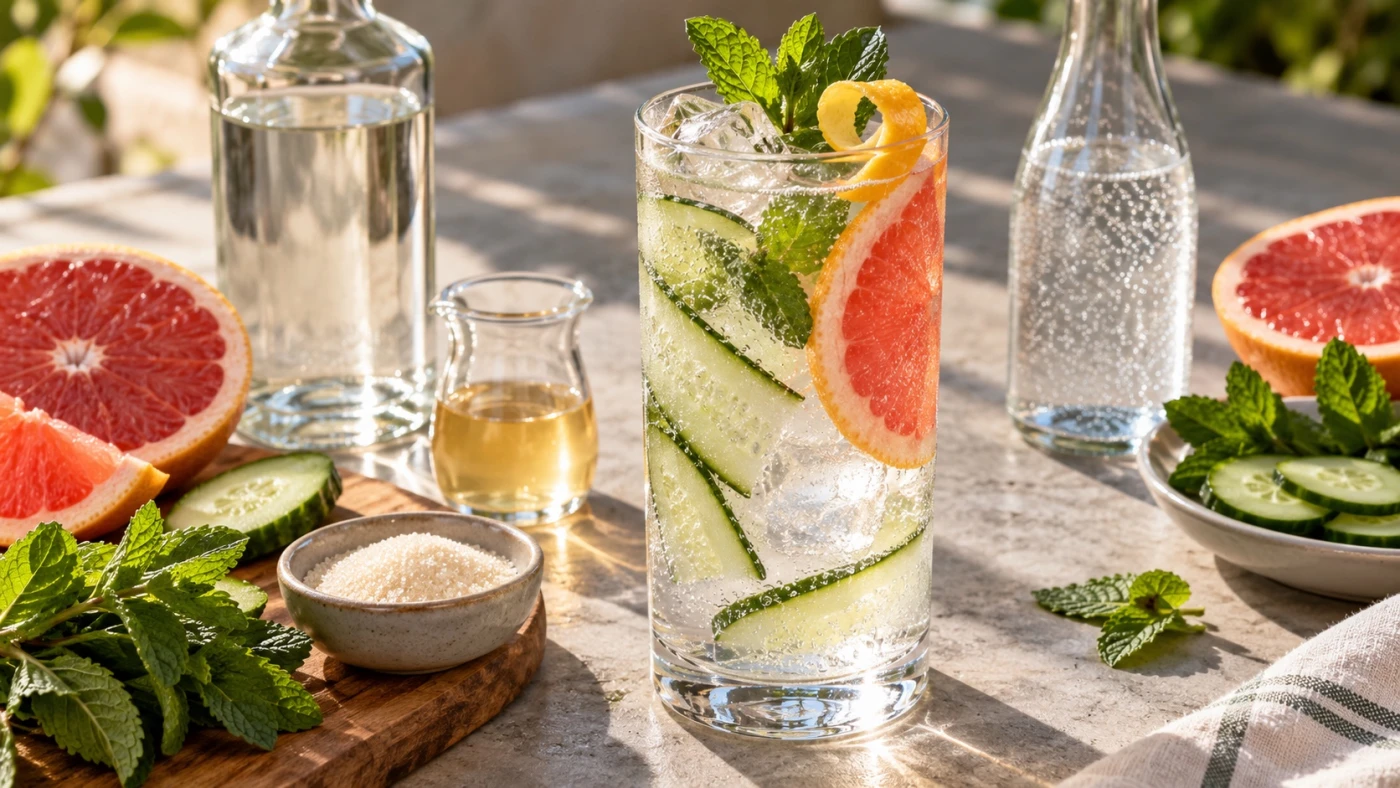
Citrus peel, mint, basil, cucumber and fresh fruit contribute aromas that reach the nose before the liquid reaches the palate. This can make a relatively simple vodka drink feel more vivid without requiring additional sugar.
Carbonation can create a brisk texture and help carry volatile aromas, but bubbles fade with agitation and time. Add a carbonated component late and stir only enough to combine it. Carbonation does not make a drink weaker unless the added mixer actually increases its volume relative to the alcohol.
Apply the concept: make one deliberate decision
Start by deciding what should lead the drink. That single choice makes the remaining decisions easier.
| Desired result | Vodka decision | Supporting direction | Watch for |
|---|---|---|---|
| Clean citrus highball | Choose a neutral, clearly labeled bottling at the intended strength | Bright acid, unsweetened sparkling mixer, citrus oil | Excess mixer muting the citrus |
| Berry-led cooler | Use vodka that will not obscure delicate fruit | Tartness plus measured sweetness | Sweet fruit, liqueur and syrup stacking up |
| Cucumber-and-herb drink | Favor a clean base unless vodka character is intentional | Fresh aroma and restrained acid | Overworking herbs into bitter or vegetal flavors |
| Vodka drink with tonic | Consider whether a more textured vodka can remain perceptible | Citrus aroma and tonic's existing bitterness and sweetness | Treating every tonic as compositionally identical |
When correcting a drink, change only one factor at a time:
- Hot or harsh: confirm the vodka measure, improve chilling, then add a small measured amount of dilution if needed.
- Flat: try a small acid or aromatic adjustment before adding more spirit.
- Sour: add sweetness in small increments or increase the non-acidic portion while preserving the intended strength.
- Cloying: check whether several sweet ingredients overlap; a small acid adjustment may help, but replacing part of a sweet mixer with an unsweetened one is often more direct.
- Watery: rebuild with colder ingredients and sound ice rather than trying to rescue the glass with extra vodka.
Choosing vodka for a summer drink
Price and elaborate production language do not automatically predict suitability. Make the buying decision around the cocktail's job:
- Read the ABV. It directly affects the calculation of alcohol content and the drink's structure.
- Decide whether neutrality is desirable. Delicate cucumber or floral combinations may benefit from restraint, while a sparse vodka-and-soda format leaves more room for the spirit's texture and subtle aroma to register.
- Separate flavored vodka from an infusion or liqueur. These categories can differ in sweetness and strength. Read the exact label rather than assuming they behave alike.
- Do not pay for a claim you cannot use. If juice, sweet soda and strongly aromatic fruit dominate the drink, fine distinctions between premium bottlings may be difficult to perceive.
Production methods and sensory effects differ among brands. Unless a producer supplies verifiable details, broad claims that a particular number of distillations or filtrations guarantees superior smoothness should be treated cautiously.
Common misconceptions
“More ice always makes a drink more watery.” Ice causes dilution when it melts, but the rate depends on heat transfer, ice condition and time. A properly filled glass of solid ice can chill a drink efficiently and may be more consistent than a few rapidly diminishing cubes.
“Vodka disappears under fruit, so the measure does not matter.” Sweetness, acidity and cold can reduce the perception of alcohol without reducing the amount consumed. The US National Institute on Alcohol Abuse and Alcoholism notes that 1.5 US fl oz of 40% ABV distilled spirits contains approximately one US standard drink, and a mixed drink can contain one or more. NIAAA standard-drink guidance provides the underlying definition.
“Premium vodka automatically makes the best summer cocktail.” Suitability depends on the surrounding flavors and the role assigned to the spirit. A subtle difference that matters in a vodka soda may vanish in a strongly flavored punch.
“All clear mixers are neutral.” Tonic water, lemon-lime soda, sparkling water and flavored seltzer contribute different combinations of sweetness, bitterness, acidity and aroma. Substitution changes the balance even when the volume remains identical.
“There is one perfect sweet-to-sour ratio.” Fruit ripeness, juice acidity, mixer composition, dilution and serving temperature all vary. Ratios provide repeatable starting points, but tasting the completed drink remains essential.
Evidence and uncertainty notes
Label ABV and measured ingredient volumes support useful strength calculations, but the final in-glass ABV remains an estimate unless meltwater is measured. Sensory terms such as “crisp,” “smooth” and “refreshing” are not laboratory measurements and can differ among drinkers.
US standard drinks and UK alcohol units are different systems. In the UK, units are calculated from beverage volume and ABV; Drinkaware gives 25 ml of a 40% ABV spirit as approximately one UK unit. Drinkaware's spirits guidance explains that convention. Neither a standard drink nor a unit is a recommended cocktail size, and neither guarantees that a customary mixed drink contains only one.
The practical rule to remember
A successful summer vodka cocktail is not merely vodka plus something cold. It is a controlled relationship among spirit strength, dilution, acid, sweetness and aroma. Choose which flavor should lead, measure the alcohol, account for every sweet component, chill efficiently and correct only one variable at a time. That framework is more useful than memorizing a long list of seasonal drink names because it lets you diagnose the glass in front of you.
Ask AI about this article
Pick a prompt, copy it, or open ChatGPT with this article preloaded.
Frequently Asked Questions
Why does a vodka soda sometimes taste harsh even when it contains plenty of soda?
Volume alone does not create balance. A long drink can still taste angular if it lacks acidity, aroma or sufficient chilling, or if the vodka measure is large relative to the total liquid. First confirm the measure, then improve temperature and consider a small acidic or aromatic component rather than automatically add.
Should fruit be sweeter than usual in a summer vodka cocktail?
Not automatically. Very ripe fruit may already supply substantial sugar, while tart fruit may require more sweetening. Judge the finished mixture rather than the fruit in isolation, because cold temperature, acidity and dilution all affect how sweet the drink appears.
Does using flavored vodka remove the need for fresh aromatic ingredients?
No. Flavored vodka can establish a base flavor, but fresh peel, herbs or fruit may add volatile aromas that are most noticeable near the surface of the drink. Use those ingredients deliberately, however; too many competing aromas can make a light summer cocktail taste indistinct.
How can I compare the strength of two summer vodka drinks?
Compare the volume and ABV of every alcoholic ingredient, not the apparent size of the glasses. Multiply each alcoholic ingredient's volume by its ABV, add those alcohol volumes, and divide by the drink's total liquid volume for an approximate pre-ice ABV.
Comments 0
Login to Post comments