
How to Make Frozen Vodka Drinks That Are Not Watery
The knowledge question is simple: what makes a vodka cocktail form a smooth slush instead of becoming a glass of flavoured water and floating ice? Once…
- Once you understand how water, alcohol, sugar, temperature, and blending interact, you can diagnose a thin frozen drink and decide what to change.
- The aim is not to find one universal ratio.
- It is to create enough fine ice to give the drink structure while keeping enough unfrozen liquid for it to move through the blender and pour.
- Weak flavour: melting ice has diluted the fruit, citrus, sweetness, and vodka.
- Loose texture: the mixture is cold but does not contain enough ice crystals to hold a slushy consistency.
The knowledge question is simple: what makes a vodka cocktail form a smooth slush instead of becoming a glass of flavoured water and floating ice?
Once you understand how water, alcohol, sugar, temperature, and blending interact, you can diagnose a thin frozen drink and decide what to change. The aim is not to find one universal ratio. It is to create enough fine ice to give the drink structure while keeping enough unfrozen liquid for it to move through the blender and pour.
What “not watery” actually means
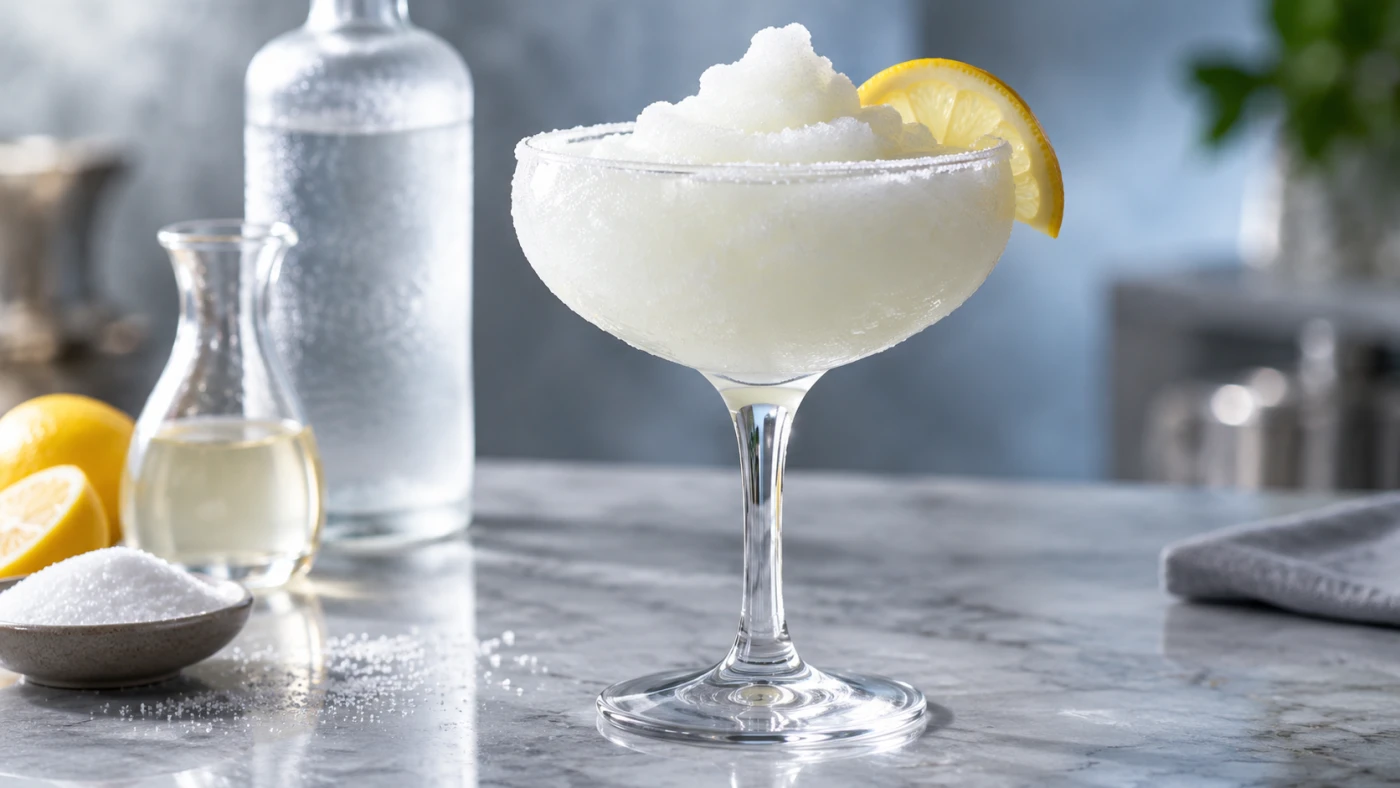
A successful frozen vodka drink is a suspension of small ice crystals in a concentrated, flavourful liquid. The crystals create body; the liquid keeps the drink pourable. If too little water freezes, the cocktail is thin. If too much freezes—or the crystals remain large—the drink becomes stiff, coarse, or difficult to blend.
“Watery” can describe three different faults:
- Weak flavour: melting ice has diluted the fruit, citrus, sweetness, and vodka.
- Loose texture: the mixture is cold but does not contain enough ice crystals to hold a slushy consistency.
- Separation: liquid drains to the bottom while coarse ice accumulates above it.
These faults can occur together, but they do not always have the same solution. Adding more ice may help a warm, loose drink; it will not repair an unbalanced base indefinitely.
Why vodka, sugar, and water do not freeze together
Pure water forms ice more readily than a mixture containing ethanol and dissolved sugar. Both alcohol and sugar lower the freezing point of the liquid. In practical cocktail terms, increasing either one generally means that a colder mixture is required before the same proportion of water becomes ice.
This is why a glass of sweetened juice, a standard-strength vodka, and a mixed cocktail do not behave identically in a freezer. The final drink is a solution with its own freezing behaviour. As ice forms, it is mostly water; alcohol, sugar, acids, and flavour compounds become more concentrated in the remaining liquid. The University of Illinois' Physics Van explanation of freezing solutions describes how dissolved substances are largely excluded from ice and lower the solution's freezing point. NC State's chemistry overview also explains why ethanol freezes at a much lower temperature than water.
That does not make alcohol or sugar undesirable. Vodka supplies the drink's alcoholic base, while sugar contributes flavour balance and body. The problem is excess: a mixture can contain so much dissolved material that an ordinary home freezer or a brief spin with ice produces too little frozen water for a stable slush.
The five controls that determine frozen texture
1. Starting temperature
Ice must first cool warm ingredients before it can remain in the drink as structural ice. During that cooling, some of it melts and becomes dilution. Refrigerating juice and syrups, chilling the vodka, and using a cold glass preserve more of the ice you add.
Freezer-cold vodka remains liquid because of its alcohol content, but that does not mean vodka alone creates a frozen texture. Its advantage is that it contributes less heat to the blender than a room-temperature spirit.
2. The amount of free water
Juice, soft drinks, tea, fruit purée, syrup, and melting ice all contribute water. A common failure is to build a full liquid cocktail and then add enough ice to make it cold. The blender may crush that ice, but the large liquid load can still produce a thin result.
For a fruit-forward drink, freezing part of the fruit or mixer changes the equation: the frozen component supplies cooling and flavour at the same time. Plain ice remains useful for adjusting texture, but it should not have to compensate for every ingredient entering the blender warm.
3. Alcohol concentration
Check the vodka label rather than assuming every bottle has the same strength. The US Alcohol and Tobacco Tax and Trade Bureau requires distilled-spirits labels to state alcohol content by volume, as explained in its alcohol-content labeling guidance.
If you replace a standard-strength vodka with a higher-proof bottling while keeping every other component unchanged, expect the mixture to resist freezing more strongly. Either use less of the stronger spirit, accept a softer texture, or redesign the complete balance. The appropriate choice depends on whether texture or alcoholic strength is the priority.
4. Sugar and fruit solids
Sugar has two relevant effects. It lowers the freezing point, which can make a heavily sweetened mixture softer, but it also increases the viscosity of the unfrozen liquid and can make the drink feel fuller. Consequently, “more sugar makes it thicker” is only partly true. Moderate sweetness may support body; excessive sweetness can prevent enough ice from forming.
Whole-fruit purées add fibre and other solids as well as sugar and water. They often produce more apparent body than clarified juice, but they can also make a drink pulpy or foamy. Choose them for the style you want rather than treating all fruit products as equivalent.
5. Ice size and blending
Small, evenly distributed crystals feel smoother and separate more slowly than a mixture containing large shards. Add frozen components progressively so the blades continue circulating the mixture. If a hollow pocket forms around the blades, stop the blender before adjusting or scraping down the contents according to the manufacturer's safety directions.
Longer blending is not automatically better. The motor and friction introduce heat, while prolonged crushing can melt more ice. Stop when the texture becomes even and pourable rather than continuing in pursuit of an arbitrary blending time.
How to apply the science to your next drink
| What you observe | Likely cause | Useful adjustment |
|---|---|---|
| Thin immediately after blending | Warm ingredients, too much liquid, or too little frozen material | Chill the base and add ice or a compatible frozen ingredient gradually |
| Thick at first, watery within minutes | Warm glass or surroundings, coarse ice, or excessive blending heat | Use chilled glasses, produce finer crystals, blend only until uniform, and serve promptly |
| Liquid base with stubborn ice chunks | Poor circulation or frozen components added too quickly | Stop safely, redistribute the contents, and resume in short pulses |
| Cold but never truly slushy | Alcohol or sugar concentration may be too high for the available temperature | Rebalance the base rather than repeatedly adding ice |
| Good texture but muted flavour | Dilution has outpaced flavour concentration | Freeze part of the mixer or fruit instead of relying entirely on plain ice |
For buying decisions, prioritise the vodka's labeled alcohol strength over claims that a particular brand is inherently “best for frozen drinks.” A clean-tasting vodka at a predictable strength is easy to formulate around. Higher proof is not a quality shortcut, and premium price alone does not guarantee better frozen texture.
For mixing decisions, make one controlled change at a time. If a drink is both warm and over-sweet, adding more ice changes temperature, water content, sweetness, and alcoholic strength simultaneously. Record what went into the blender, chill the ingredients next time, and then adjust the part responsible for the fault.
Common misconceptions
“More ice always makes a thicker drink.” More ice can thicken a warm or under-iced mixture, but the improvement may be temporary if that ice melts quickly. It also dilutes flavour.
“More vodka stops the drink tasting watery.” Extra vodka increases flavour and alcoholic strength, but it also lowers the mixture's freezing point. The result can taste stronger while becoming texturally looser.
“Sugar is a foolproof thickener.” Sugar raises viscosity but also suppresses freezing. Past the useful balance, additional syrup can make a drink sweeter and less frozen.
“A powerful blender solves the formula.” A blender controls particle size; it cannot make an over-alcoholic, over-sweet, or excessively warm base form the required amount of ice.
“A frozen cocktail should stay unchanged.” It begins melting as soon as its environment supplies heat. Good formulation slows the decline and preserves flavour as it happens; it does not suspend the laws of heat transfer.
What cannot be reduced to one perfect ratio
There is no defensible universal formula for every frozen vodka cocktail. Fruit sugar varies, commercial mixers differ in concentration, vodka strength changes between products and markets, freezer performance varies, and blender designs process ice differently. Even fresh fruit changes with ripeness and water content.
The reliable principle is comparative: colder ingredients require less ice-melting energy; more alcohol or dissolved sugar generally suppresses freezing; and flavour-bearing frozen components dilute less than plain ice. Use those relationships to make a deliberate adjustment, then judge the drink's texture and flavour together.
Evidence notes
The freezing explanation above is grounded in general solution chemistry: dissolved alcohol and sugar lower the freezing point, and forming ice concentrates those substances in the remaining liquid. The practical guidance—pre-chilling ingredients, limiting unnecessary water, using frozen fruit or mixer, and stopping once uniformly blended—is an editorial application of those principles.
Exact freezing behaviour cannot be predicted from a drink's vodka quantity alone. A precise calculation would require the complete formulation, ingredient concentrations, starting temperature, and equipment conditions. Where those data are unavailable, texture recommendations should be treated as starting decisions rather than guaranteed results.
Ask AI about this article
Pick a prompt, copy it, or open ChatGPT with this article preloaded.
Frequently Asked Questions
Why does my frozen vodka drink separate after blending?
Separation usually means the drink contains large, uneven ice particles or too much liquid relative to its ice fraction. Starting with cold ingredients, adding ice or other frozen components gradually, and stopping once the texture is uniform can improve stability. Some settling is still normal because a frozen cocktai.
Does stronger vodka make a frozen cocktail thicker?
Usually not. More alcohol lowers the mixture's freezing point and can leave less water frozen at a given temperature, producing a looser slush. A higher-proof vodka can work, but the rest of the drink must be formulated around it rather than treated as interchangeable with standard-strength vodka.
How can I fix a frozen cocktail that is already watery?
First identify whether it is warm, over-diluted, or unable to freeze because it contains too much alcohol or sugar. Blend in a small amount of frozen fruit, frozen mixer, or fresh ice as appropriate. If the base itself is over-concentrated in alcohol or sugar, adding ice alone may only give a brief improvement; the liq.
Comments 0
Login to Post comments